
Representations, warranties, and indemnities decide who pays when the story breaks. In cross-border M&A the underlying jurisdiction is always in the background, shaping how that risk allocation actually works. Matthias De Buck (CapstoneLaw) explains the traps, the “standard” clauses with teeth, and why due diligence only counts when it changes the drafting.
From the Commercial Side of the Table to Legal Practice
Matthias did not arrive in M&A through a purely conventional route. Before joining CapstoneLaw, he worked at managers of collective assets, which gave him sustained exposure to the commercial realities of transactions: the incentives, the pressure points, and the uncomfortable truth that “legal” and “commercial” risk are often two sides of the same coin.
That background shows up in how he frames drafting as not a textbook exercise, but grounded in real deal dynamics. Every transaction is a translation exercise, with commercial objectives and modelled assumptions turned into enforceable allocation of risk. And translations often fail in predictable places.
“The devil isn’t in the details. The devil is the detail.”
Representations and Warranties Are Not Semantics
“Representations” and “Warranties” are often treated as interchangeable shorthand. In many transactions, that shorthand is harmless. But in some jurisdictions they are not conceptually identical, and the distinction can matter. Most acutely when a deal goes wrong, and definitions stop being theoretical and start doing real work.
At a high level:
- A representation can be seen as a statement of fact used to induce entry into the agreement;
- A warranty can be seen as a contractual promise that a stated fact is true, typically enforced through a contractual damages regime
But the point here isn’t the dictionary definition. It’s that the same sentence can have different meaning depending on governing law, reliance language, and the remedial architecture that’s in place.
So the real questions become:
- If this statement is wrong, what cause of action survives?
- What remedies are realistically available?
- What have you excluded or preserved?
This is where M&A representations and warranties UK vs US stops being a midnight ChatGPT query while you’re rereading the SPA and starts being a real risk allocation decision.
UK vs US Is Not a Stylistic Preference
If you work on risk allocation in cross-border M&A, you know that jurisdiction matters.
In England and Wales, misrepresentation and warranty breach sit in different lanes. Rescission is often difficult post-completion for practical reasons; but even the theoretical availability shifts leverage. This is why careful drafters sweat the small stuff.
In the US, outcomes are more contract-driven. State law matters, but disputes typically turn on what the SPA says.
The key point isn't "UK clean, US blurred." The question is whether, under the governing law, you’ve drafted a remedial system you can live with under stress.
“The distinction isn’t semantics. It’s about control, risk allocation, and money.”
Indemnities Are Not a Nicer Warranty
Indemnities are a different tool. Representations and warranties police the information baseline. Indemnities isolate known risks and price them as specific obligations.
This is where legal due diligence and indemnities connect directly to drafting. If due diligence turns up a discrete, nameable issue (tax, share capital, environmental exposure, litigation, regulatory matters), an indemnity can attach a euro-for-euro outcome to that issue without forcing the buyer to fight about breach theory.
"Reps and warranties work together with indemnities like Batman and Robin, but they have very different roles."
Due Diligence Only Matters if It Changes the Paper
Buyers still live under caveat emptor. Whether you acquire shares or assets , the law doesn't hand you a warranty package. You have to build it.
Matthias's advice sounds obvious until you see how often it's ignored: tie warranties and indemnities to what diligence actually revealed. Expand where blind spots remain. Narrow where specific certainty exists. Treat "standard" clauses as suspect until proven safe.
"Boilerplates might seem boring and standardized. But they can hide very sharp teeth."
Where This Is Going Next
The structural change is that the centre of gravity shifts away from manual document digestion and toward earlier, more explicit risk decisions.
Deal teams that win will use speed to buy clarity:
- Faster synthesis of diligence inputs
- Earlier identification of true deal-breakers vs manageable issues
- More time spent on judgement calls, negotiation strategy, and drafting precision
AI-assisted due diligence platforms (tools like Emma Legal) are best understood in that context: not only as “automation,” but as a reallocation of lawyer time from extraction to evaluation.
The takeaway is simple: the firms that treat diligence as a strategic function, not a production function, will draft better risk allocation and negotiate from a cleaner position.
Other related podcasts

Why Most Law Firm Transformations Fail. And What Real Modernization Actually Requires
Legal AI adoption in M&A law firms often fails due to weak strategy, culture, and change management, not technology revealing deeper structural issues in legal due diligence workflows.
How Emma Legal Turns Data Rooms Into Insight
Rick van Esch explains how AI-driven playbooks and structured data rooms transform M&A due diligence from bottleneck to strategic advantage.
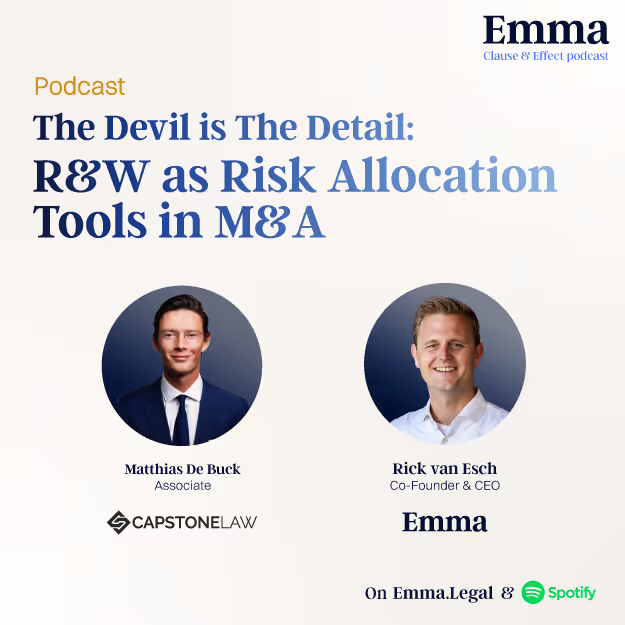
The Devil is the Detail: R&W as Risk Allocation Tools in M&A
A senior, practice-driven analysis of how representations, warranties, and indemnities actually allocate risk in cross-border M&A and why due diligence only matters when it changes the drafting.